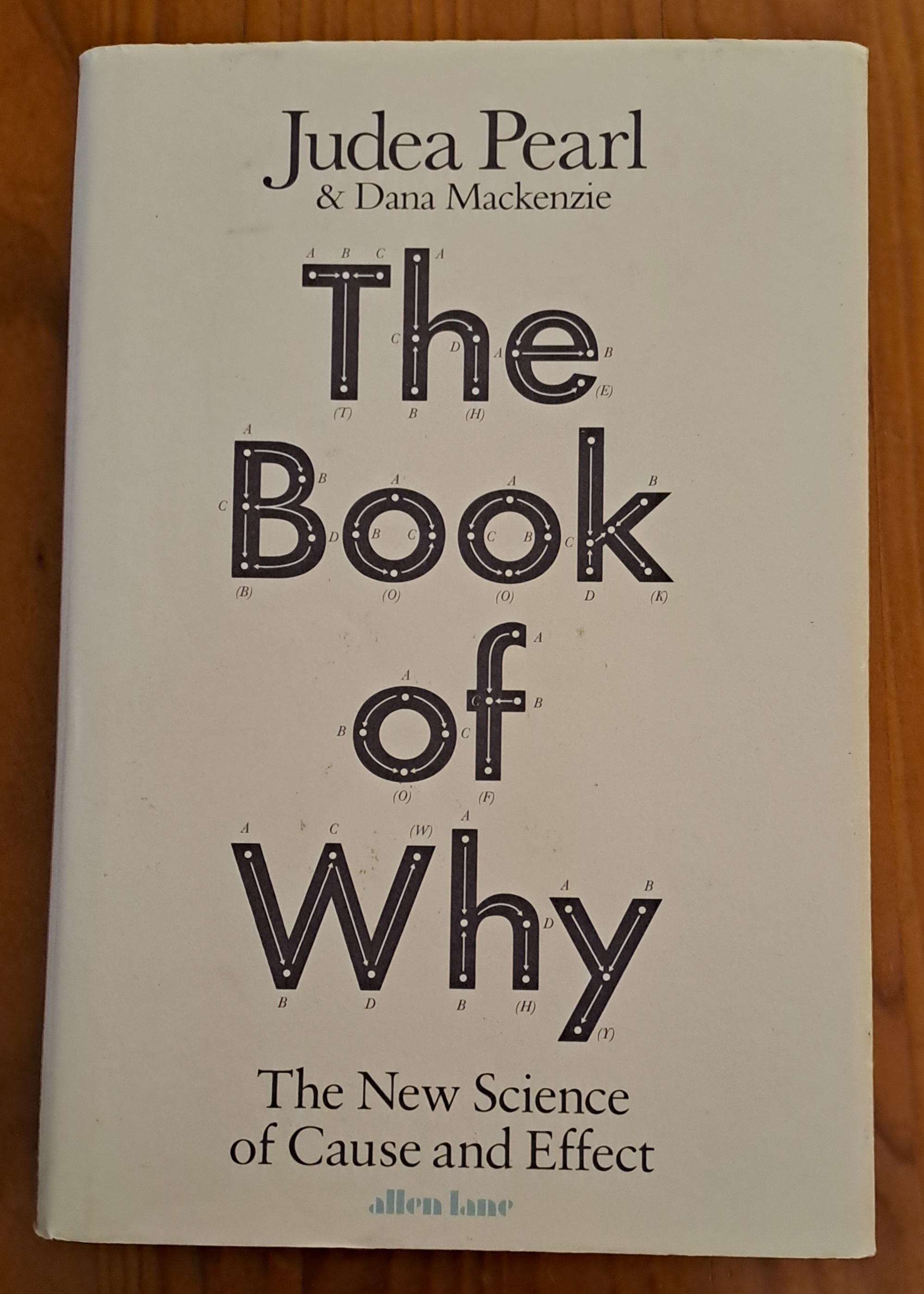
TL;DR
The Book of Why argues that data alone cannot explain the world. Judea Pearl shows why correlation is not enough, introduces a clear framework for causal reasoning, and explains how causal models let us answer the questions that matter: what happens if we intervene, and what would have happened otherwise? It is a call to move beyond prediction and toward genuine understanding: in science, AI, and everyday decision-making.
The Full Story
The Hook
What if most of what we call “data-driven insight” is fundamentally unable to answer the questions we actually care about? In The Book of Why, Judea Pearl makes a provocative claim: modern data analysis excels at finding patterns, yet often fails at explaining why things happen. And without “why”, prediction alone is not the same as understanding.
The Big Idea
At the heart of the book is a simple but radical message: correlation is not causation, and pretending otherwise limits science, policy, and artificial intelligence. Judea Pearl argues that we need a formal language of causation - one that allows us to reason about interventions, explanations, and counterfactuals, not just associations in data.
To do this, he introduces a rigorous framework based on causal models, diagrams, and logical rules that make assumptions explicit rather than hidden.
How It Works?
A key tool in the book is the use of causal diagrams (directed acyclic graphs) - simple arrows that encode how variables influence one another. These diagrams clarify which variables should be controlled for, and which should not, something traditional statistical approaches often get wrong.
Judea Pearl uses Simpson’s paradox as a recurring example: situations where a trend appears in every subgroup but reverses when the data are combined. The paradox is not a statistical oddity; it is a signal that causal structure has been ignored. Once the causal relationships are made explicit, the paradox dissolves.
The book also explains why adjusting for the wrong variable, such as a collider, can introduce bias rather than remove it. These ideas are counterintuitive when learned through equations alone, but become immediately clear when visualised causally.
The Plot Twist
One of the most striking ideas in The Book of Why is the Ladder of Causation, a three-level hierarchy of reasoning:
- Seeing - observing correlations (“What is?”)
- Doing - intervening (“What happens if we do X?”)
- Imagining - counterfactuals (“What would have happened if…?”)
Judea Pearl argues that much of modern machine learning and AI is stuck on the first rung. These systems can predict extremely well, yet fail when asked simple causal questions. A model that cannot reason about interventions or counterfactuals, he argues, is fundamentally limited, no matter how impressive its accuracy.
Why Should Scientists Care?
For scientists, the book is a direct challenge to decades of methodological caution that discouraged causal language. Judea Pearl argues that avoiding words like “cause” and “effect” did not make science safer - it made it less honest about its assumptions.
Causal models do not eliminate uncertainty: they expose it. By making assumptions explicit and testable, they allow disagreements to be resolved logically rather than rhetorically. From epidemiology to economics, the book shows how causal reasoning can settle questions that statistics alone could not.
Why Should Non-Scientists Care?
Because real-world decisions are causal by nature. When we ask whether a treatment works, a policy helps, or an action caused harm, we are not asking about correlations, we are asking what would happen if we acted differently.
The Book of Why equips readers with a way to think clearly about such questions. It explains why “the data says so” is often not enough, and why understanding cause and effect is essential for medicine, public policy, law, and everyday reasoning.
The BioLogical Footnote
Judea Pearl’s message is empowering: we are allowed to ask why - and we now have the tools to answer it properly.
“Prediction can be impressive, but explanation is transformative.”